

Before re-listing a rental, you don't need a full renovation to see strong returns. Targeted updates like cabinet repainting ($200–$800), modern fixtures ($300–$700), and LED lighting ($150–$400) can boost perceived value for under $1,100 while commanding $300–$500 more in monthly rent. Stick to a budget at or below 10% of your annual gross rent, prioritize function over aesthetics, and focus on speed. The right strategy makes all the difference.
Key Takeaways
- Cosmetic upgrades like repainting cabinets and replacing hardware deliver strong ROI at low cost, often under $1,100 combined.
- Fixture upgrades—lighting, faucets, and sinks—yield 60–80% ROI and signal quality to prospective tenants.
- Keep renovation budgets at or below 10% of annual gross rent to maintain healthy returns.
- Full renovations are only justified when deferred maintenance is significant or market rents could increase $300–$500.
- Speed matters—quick, targeted updates minimize vacancy periods and prevent daily revenue loss.
What Renters Actually Notice in a Kitchen
When renters walk into a kitchen, they're not evaluating it the way a homeowner would—they're scanning for functionality and cleanliness in seconds. Research consistently shows that tenant preferences center on counter space, storage, and appliance condition before anything else.
Kitchen aesthetics matter, but only after those fundamentals check out.
What actually registers quickly: grimy grout, broken cabinet hinges, outdated faucets, and poor lighting. These details signal neglect, and neglect signals risk. Renters interpret visible wear as a preview of how maintenance requests will be handled. It's crucial to ensure that tenant responsibilities for maintenance are clear to prevent misunderstandings.
You don't need a full remodel to shift that perception. Targeted updates—fresh caulk, functioning hardware, clean surfaces—communicate that the property is well-managed.
That impression directly influences application rates and the caliber of tenants you attract.
High-ROI Updates That Cost Under $2,000
You don't need a full gut renovation to move the needle on rental value—targeted updates under $2,000 consistently deliver the strongest returns.
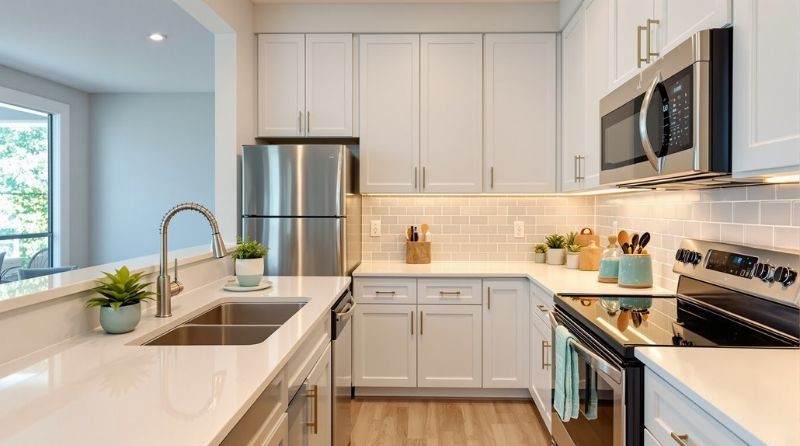
Repainting or refacing cabinets can transform a kitchen's appearance for a fraction of replacement costs, often running between $200 and $800 depending on scope.
Swapping out dated faucets, hardware, and light fixtures for modern finishes adds the visual polish tenants notice most, typically costing $300 to $700 for the full package. This approach aligns with RentalRiff's commitment to excellent service and improving customers' lives through thoughtful updates.
Budget-Friendly Cabinet Refreshes
Cabinet updates deliver some of the strongest returns in rental kitchen renovations—often recouping 70–80% of costs—without requiring a full replacement.
If your cabinets are structurally sound, you're leaving money on the table by replacing them outright.
Cabinet painting typically runs $300–$800 for a standard kitchen and instantly modernizes dated wood tones or worn finishes.
Stick with neutral tones—whites, grays, or soft greiges—that appeal to the widest tenant pool.
Hardware replacement adds another layer of impact for $100–$300, with brushed nickel and matte black finishes consistently testing well in rental markets.
Together, these two updates can transform a kitchen's perceived value for under $1,100, improving your re-listing photos, attracting stronger applicants, and justifying competitive rental pricing in your market.
Affordable Fixture Upgrades
Three fixture upgrades—lighting, faucets, and sinks—consistently deliver outsized returns in rental kitchens, often recouping 60–80% of costs while meaningfully improving tenant perception and lease velocity.
Smart fixture selection within budget constraints means prioritizing brushed nickel or matte black finishes, which photograph well and signal quality without premium pricing.
Replace dated overhead fixtures with LED flush-mounts or pendant lighting for $150–$400 per unit.
Swap builder-grade faucets for pull-down models in the $100–$250 range—tenants notice functionality immediately.
Stainless steel undermount sinks ($200–$500 installed) eliminate the grout-line maintenance issues that generate repeat work orders.
Combined, these three upgrades typically run $500–$1,200, well inside your $2,000 threshold, and they're among the fastest ways to justify higher asking rents in competitive rental markets.
When a Full Kitchen Renovation Makes Financial Sense
Full kitchen renovations make financial sense in three specific scenarios: when deferred maintenance has compounded to the point where piecemeal repairs cost more than a full overhaul, when market comps show renovated units commanding rents $300–$500+ per month higher than your current ask, or when competing properties are pulling tenants away due to outdated kitchens.
In tight rental markets like Seattle, Denver, or Portland, a $15,000–$25,000 full renovation can generate a payback period of just three to five years when the rent increase is substantial enough. Additionally, addressing these renovations promptly can help avoid higher long-term costs associated with deferred maintenance issues.
You need to run the numbers against your local market before committing, but when all three conditions align, a full renovation shifts from an expense to a calculated investment.
Significant Deferred Maintenance Exists
Sometimes the math on a full kitchen renovation makes sense—and deferred maintenance is one of the clearest cases. If your rental has a maintenance backlog—failing appliances, deteriorating cabinets, outdated plumbing, or damaged flooring—you're already facing multiple repair invoices.
Bundling those deferred repairs into a single, coordinated renovation is often more cost-effective than addressing each issue separately across multiple contractor visits.
The financial logic is straightforward. Scattered repairs carry redundant labor costs and repeated disruption. A consolidated renovation eliminates that inefficiency while simultaneously upgrading the unit's appeal and rental value.
If deferred maintenance already totals 60–70% of a moderate renovation budget, closing that gap with a full project frequently delivers stronger ROI than piecemeal fixes that still leave the kitchen underperforming in a competitive rental market.
Major Rent Increases Possible
Beyond consolidating deferred maintenance costs, a full kitchen renovation can directly access a higher rent tier—sometimes considerably.
In competitive rental markets like Seattle, Denver, or San Diego, updated kitchens regularly command 10–20% rent increases over comparable units with dated finishes. That gap matters enormously when you're setting rent pricing for a newly listed vacancy.
Tenant expectations have shifted. Renters increasingly treat the kitchen as a dealbreaker, not an afterthought.
Stainless appliances, quartz countertops, and functional layouts aren't luxury signals anymore—they're baseline expectations in mid-to-upper rental segments.
If your current rent sits near the ceiling of its tier, a full renovation can reposition the property entirely.
You're not just revitalizing a space—you're justifying a structural rent increase that compounds across every future lease term.
Competitive Market Conditions
A full kitchen renovation isn't the right move in every market—but in high-demand rental cities like Seattle, Denver, and San Diego, the math shifts decisively in its favor.
When vacancy rates are low and qualified tenants have options, market trends show that updated kitchens consistently outperform dated ones in both time-to-lease and rental rate achieved.
Tenant preferences in competitive markets skew heavily toward modern finishes, functional layouts, and quality appliances.
When comparable units nearby offer those features, your unrenovated kitchen becomes a liability, not a neutral factor. You risk longer vacancies and downward pressure on rent.
In markets where demand supports premium pricing, a strategic kitchen renovation doesn't just recover its cost—it actively strengthens your property's competitive position for years ahead.
Cosmetic Fixes vs. Structural Upgrades: Know the Difference
When planning a kitchen renovation, knowing the difference between cosmetic fixes and structural upgrades can make or break your ROI.
Cosmetic upgrades—like repainting cabinets, replacing hardware, or installing new lighting—deliver visible impact at a fraction of the cost. These changes attract tenants quickly and justify higher rents without draining your budget.
Structural integrity issues are different. Faulty plumbing, damaged subfloors, or outdated electrical systems aren't optional fixes—they're liabilities. Ignoring them increases your risk exposure and long-term repair costs considerably. In fact, timely repairs are necessary for tenant safety and compliance with local housing codes.
The smart approach: address structural problems first, then layer in cosmetic upgrades strategically.
Skipping structural issues to prioritize aesthetics is a costly mistake that catches up with you fast. Prioritize function, then appearance, and your renovation dollars will work harder for you.
How to Set a Renovation Budget Based on Your Rental's Rent Range
Setting a renovation budget without anchoring it to your rental's rent range is one of the fastest ways to kill your ROI. A common benchmark: keep your total budget allocation at or below 10% of the property's annual gross rent.
If your unit rents for $2,000/month, that's a $2,400 ceiling for kitchen upgrades before re-listing.
This framework forces smarter decisions. You'll prioritize high-impact, low-cost updates over full gut renovations that won't move the needle on rent price.
Your renovation timeline matters here too. A longer vacancy costs money, so budget for speed, not perfection.
Target updates completable within one to two weeks. Every extra day offline is lost revenue that no countertop upgrade will recover. Additionally, implementing preventive maintenance during renovations can enhance long-term tenant satisfaction and property value.
Kitchen Improvements That Help You Re-List Faster
Vacancy days are lost revenue, so the kitchen improvements you choose should be fast to execute and immediately visible to prospective tenants.
Prioritize high-impact updates that photograph well and signal move-in readiness.
- Appliance upgrades: Swap dated units for stainless steel or slate-finish appliances—renters notice these immediately and associate them with quality.
- Countertop materials: Replace laminate with quartz or butcher block; both install quickly and dramatically shift perceived value.
- Hardware and fixtures: New cabinet pulls and a modern faucet take hours to install but visually refresh the entire space.
- Deep clean and paint: A professionally cleaned kitchen with fresh neutral paint eliminates odor concerns and makes the space feel new.
These targeted updates compress your turnaround timeline without requiring a full renovation. Additionally, a well-maintained property significantly enhances tenant satisfaction, ultimately contributing to quicker re-listing and reduced vacancy periods.
Frequently Asked Questions
Can Kitchen Renovations Affect My Rental Property's Insurance Coverage or Premiums?
Yes, kitchen renovations can impact your insurance premiums. You'll want to notify your insurer before starting, as increased renovation costs and upgraded finishes can raise your property's value, creating significant insurance implications that affect your coverage limits.
Should I Renovate the Kitchen Before or After a Tenant Moves Out?
Renovate after your tenant moves out. You'll avoid disruption, accurately assess the kitchen layout, and align upgrades with current tenant preferences—maximizing ROI before re-listing without rushing decisions or cutting corners under occupancy pressure.
Do Kitchen Upgrades Increase My Rental Property's Taxable Assessed Value?
Yes, kitchen upgrades can trigger a higher tax assessment, as local assessors may adjust your property valuation after permitted work. You'll want to weigh that potential cost increase against the rental income gains you'd achieve.
How Do I Handle Tenant Complaints About the Kitchen During a Renovation?
Share your renovation timeline upfront and keep tenant communication consistent throughout. You'll reduce complaints by setting clear expectations, offering temporary kitchen solutions, and providing regular progress updates so tenants always know what's happening.
Are Permits Required for Common Kitchen Updates in Rental Properties?
Permits are often required for electrical, plumbing, and structural kitchen updates. You'll want to verify local permit types before starting, as unpermitted work can inflate renovation costs and create liability issues when re-listing your rental.
Conclusion
You don't need a full gut renovation to attract quality tenants and command higher rent. The data is clear: targeted, cost-conscious upgrades consistently outperform expensive overhauls in rental ROI. Focus your budget on what renters actually see and use daily, keep cosmetic improvements proportional to your rent range, and you'll reduce vacancy time while protecting your margins. Strategic beats extravagant every time.